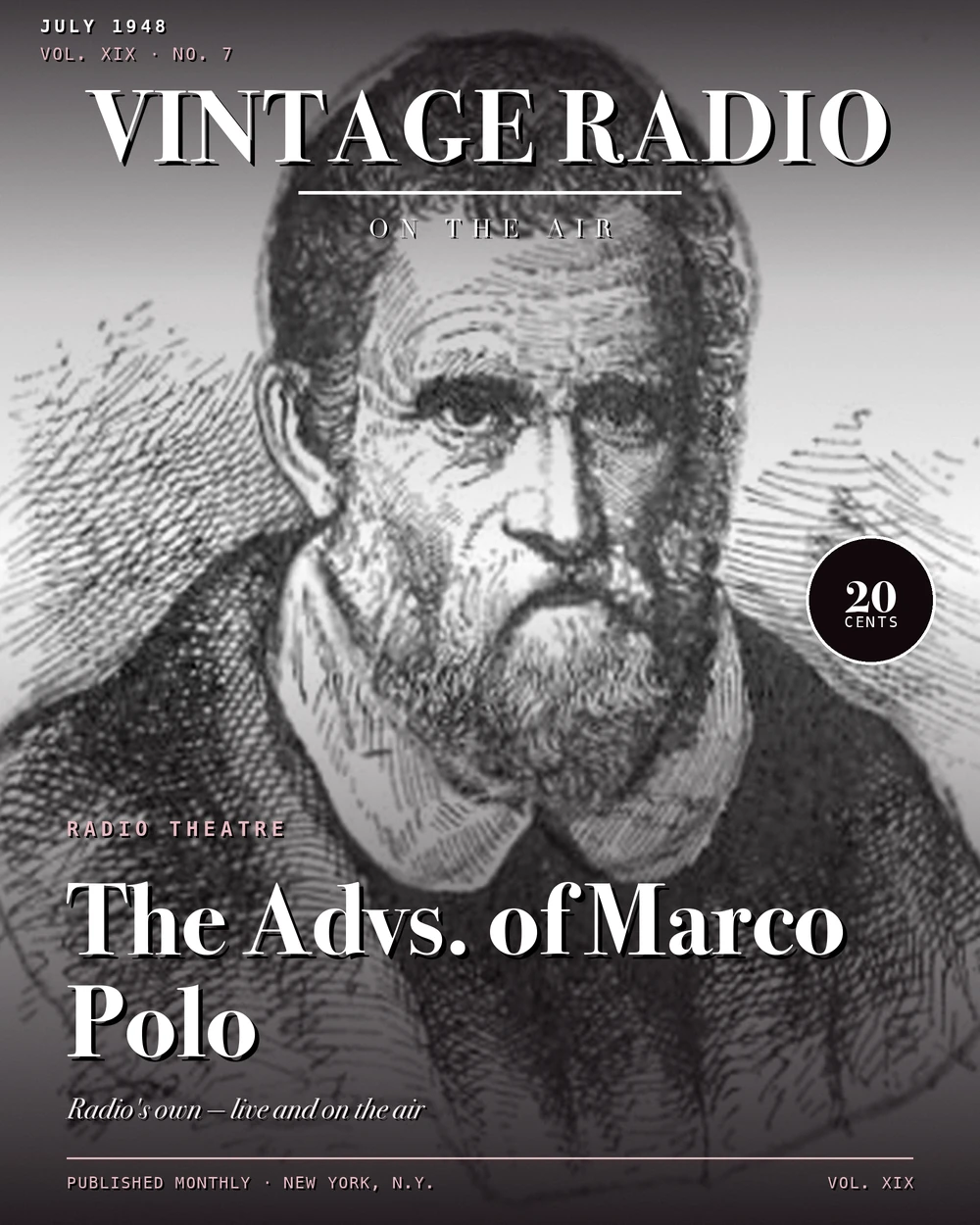
The Adventures of Marco Polo
The Show and Where It Came From
The Adventures of Marco Polo was not a Hollywood production or a stateside network serial — it came out of Australia, created and produced by George Edwards, a well-known figure in Australian radio. The series first broadcast in 1940, running as a two-a-week program with episodes of approximately 15 minutes each. It was serialized in the classic chapter format, with each installment ending on a cliffhanger designed to pull listeners back for the next episode. The show was distributed beyond Australia on 16-inch vinyl transcriptions, reaching overseas markets and earning repeat broadcasts on Australian radio throughout the 1940s and 1950s — which is likely why some sources have placed it later in the decade than it actually began.
The series drew directly from Marco Polo's own account of his travels, The Travels of Marco Polo, adapted for radio by Maurice Francis. The premise was straightforward: follow the famous 13th-century Venetian explorer as he journeyed through Asia along the Silk Road, moving from one encounter, court, and crisis to the next. Edwards brought genuine experience to the project. Before tackling Marco Polo, he had already produced multi-episode literary radio adaptations of The Corsican Brothers and Frankenstein, so he understood how to pace a long narrative across dozens of short installments.
The People Behind It
George Edwards was the central figure — producer, creator, and cast member. His wife, actress Nell Stirling, also performed in the series alongside Tom Farley, Warren Barry, and Eric Scott. This was a tight ensemble, the kind of small, committed production unit that characterized much of Australian radio drama at the time. Edwards had built his reputation on ambitious literary adaptations, and Marco Polo gave him a subject with an enormous geographical and dramatic scope to work with: a journey that spanned years and continents, with a cast of characters drawn from Venetian, Persian, Mongol, and Chinese settings.
The script adaptation by Maurice Francis kept faith with the serialized chapter structure. Episode titles followed a consistent naming convention — Chapter 29, Chapter 30, and so on — each carrying a subtitle that announced the dramatic action: Marco Asks The Khan To Let Him Escape, Acmath Captures Marco, Marco Accuses Acmath Of Being A Traitor. The chapter format gave the series a literary quality while making each episode feel like a discrete unit with its own tension and resolution. The cliffhanger ending was standard practice, but the chapter-book presentation gave it a slightly more formal frame than the typical radio thriller.
The Characters Along the Way
The recurring cast of characters reflected the breadth of Marco Polo's actual journey. Central among them was the figure known simply as the Khan — a reference to Kublai Khan, the Mongol ruler at whose court Marco Polo spent years. Around the Khan clustered a range of antagonists and allies: Acmath, who captures Marco and stands accused of treachery; Argon, whose loyalty the Khan begins to doubt; and Veno, who plots against both Marco and the Khan himself.
The series also gave Marco a more personal dimension through characters like Kin Sia, who wants to marry him, and Ziana, to whom he is eventually betrothed. Benedetta, another recurring figure, faces the threat of being sold into slavery, with King Pen Tam entering as a would-be husband whose wedding plans are repeatedly delayed. The episode titles alone map out a serial that was far more court intrigue and personal jeopardy than dry historical travelogue. The Silk Road settings served as a backdrop for a story driven by loyalty, betrayal, captivity, and survival.
How It Sounded
Edwards and his production team understood that radio adventure lives or dies on its sound. The series emphasized action over dialogue — the dramatic narrative was highly charged, and sound effects carried much of the work of building the sense of place that the story required. Bustling markets, treacherous mountain passes, palace dungeons, and royal courts all had to be conjured through audio alone. The fact that the episodes ran only about 15 minutes made efficiency essential: every scene had to move.
The musical score combined original compositions with well-known classical pieces, giving the series a varied sonic texture. This was a common approach in radio drama of the era — original themes for recurring characters or locations, classical selections to establish mood or underscore action. The newspaper Listen In published a positive review in March 1940, shortly after the series launched.
What Survives
The Adventures of Marco Polo ran to approximately 52 episodes in its original production run, with around 50 noted as surviving by multiple retail sources. The catalog here holds 46. The chapter numbering of surviving episode titles — running from Chapter 29 through Chapter 44 and beyond — suggests the collection represents the middle and later portions of Marco Polo's journey, with the earlier chapters either not surviving in the same numbers or held in different collections.
The series was syndicated on transcription discs and repeated across Australian radio for over a decade after its initial run, which helped ensure that a significant portion of the episodes survived at all. For a production of its era and origin, the survival rate is reasonably good — enough to follow Marco Polo through the Khan's court, his various imprisonments and escapes, and the long arc of his Asian years in some detail. George Edwards built the show to last, and in practical terms, it did.